Percent Error Calculator - Accurate Error Percentage Tool Online
Use our advanced Percent Error Calculator to accurately calculate the percentage error between experimental and theoretical values. This tool is ideal for students, lab experiments, physics, chemistry, and academic analysis, providing instant results with clear step-by-step explanations.
Calculation Results
Enter values and click Calculate to see error analysis
Value Comparison Visualization
Related & Other Popular Calculators
Percent Error Calculator is a tool that allows you to quickly calculate the deviation of your 'experimental' or 'observed' result compared to the 'true' or 'theoretical' result. This tool has been used extensively throughout history in many fields including mathematics, physics, chemistry, engineering, data analysis, and academic research to evaluate the accuracy and reliability of a result.
You will receive immediate results from our online percent-error calculator, along with an easy-to-read explanation, breakdown of the mathematical formula used, graphic comparisons and step-by-step calculations for your findings; thus, the percent-error calculator is ideal for students, teachers, scientists and other professionals.
What is Percent Error?
The Percent Error is a way to express mathematically the difference between an experimental value and a "true" (accepted) value. It indicates how accurately your result matches up with the expected result.
Using the Percent Error Calculator means you can avoid making errors when doing manual calculations and can see very quickly whether or not your result is accurate, acceptable, or requires further action to improve its quality.
Percent Error Formula (Used in This Calculator)
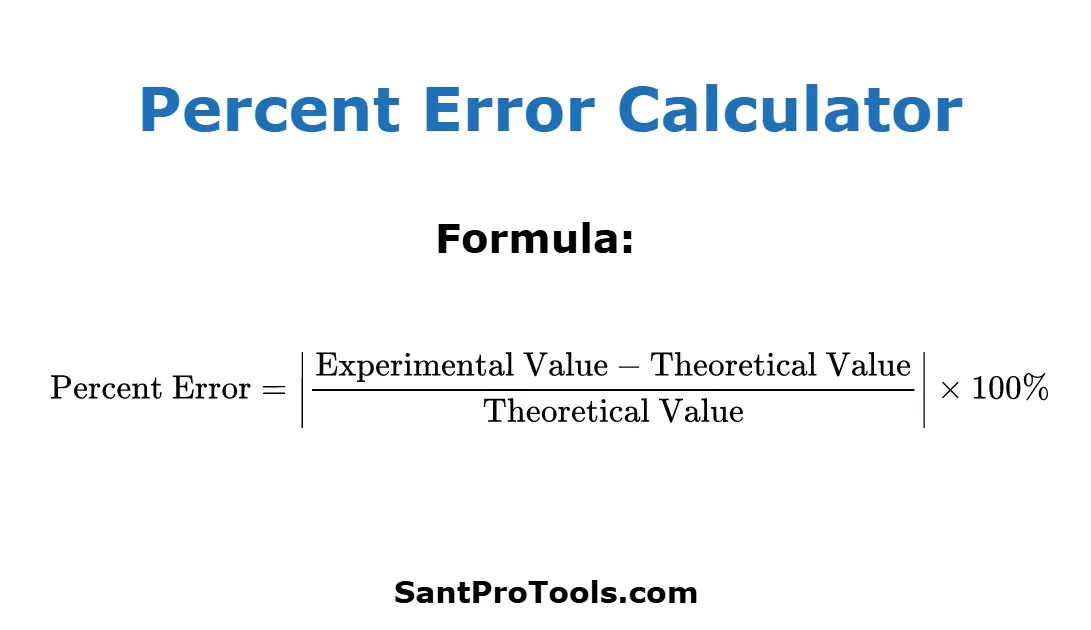
The standard percent error formula is:
Percent Error = |(Experimental - Theoretical) / Theoretical| x 100%
Where:
This Percent Error Calculator automatically applies the formula and displays results with accuracy classification.
How to Use the Percent Error Calculator
Using our Percent Error Calculator is simple and requires only two values:
The calculator instantly shows:
Why Use Our Percent Error Calculator?
The Percent Error Calculator is an excellent tool for both beginners and experienced users as it offers:
Whether you are checking your laboratory results or working on an examination problem, this percent error calculator will always give you the precision you need.
Understanding Percent Error Results
Positive vs Negative Percent Error:-
Positive Percent Error → Experimental value is greater than theoretical value
Negative Percent Error → Experimental value is less than theoretical value
Accuracy Interpretation:-
0% → Perfect accuracy
< 5% → High accuracy
5-10% → Acceptable accuracy
> 10% → Low accuracy
Our Percent Error Calculator automatically interprets these results for clarity.
Uses of Percent Error
Percent Error Calculators are useful in many different areas, such as:
This tool makes it easy to assess inaccuracies between your expected & actual results by providing you with a standard method of calculating your percent error.
Advantages of Using Percent Error Calculator Online
This is why the Percent Error calculator is one of the most valuable tools available for everyday calculations.
Built with the latest technology to ensure you can have immediate access to your calculations regardless of where you are, the Percent Error Calculator provides a dependable way to measure your errors precisely, so you can have confidence in your results, whether working on school projects, professional calculations, or experimental testing.
FAQs
A percent error of 0 indicates that the experimental value matches perfectly with the theoretical value - perfect accuracy.
Yes, when the calculated percent error is negative; it shows that the measured value was less than the accepted value.
The absolute value allows for measuring how large an error is without regard to the direction of the error's size.
Not at all, percent error compares a measured value to an accepted 'true' value while percent difference simply compares two estimated values.
This calculator can be utilized by anyone, including but not limited to students, teachers, engineers, researchers and/or analysts.
Absolutely; this calculator is free of charge and does not require any sign-up options to access its use.